
Independent Living vs Staying at Home: Daily Life, Freedom & Friends

Updated: 2 days ago

Independent living suits seniors who want more free time, built-in friendships, and no home upkeep. Staying at home suits people with steady social connections, a manageable house, and nearby help already in place. The better choice depends on how your weeks feel right now: busy and connected, or full of chores and quiet afternoons.
Key Takeaways
Staying home keeps familiar routines, but house upkeep often quietly eats the time retirement was supposed to free up.
A senior living community bundles meals, housekeeping, and transportation, so your calendar fills with activities instead of errands.
Friendships form more easily when neighbors, dining, and events share one roof.
Staying at home still works well for people with strong local ties, a manageable house, and an easy social routine.
A personal tour or short-term stay lets you experience daily life before making any decision.
The gutters need cleaning again. The lawn service canceled. And the only real conversation today was with the grocery cashier.
It's a story plenty of families recognize. And it often starts the conversation about independent living vs staying at home.
You're far from alone in wanting to stay put. AARP's Home and Community Preferences Survey found that roughly three in four adults 50 and older in the United States hope to remain in their current homes as they age. But wanting to stay and loving how your days feel aren't always the same thing.
At Victorian Gardens, a family-owned retirement community in Eureka, Missouri, we walk families through this decision regularly. So here's an honest, side-by-side look at both options across daily life, freedom, and friendships. We'll also cover when staying home still makes sense, plus a simple 5-step way to decide.
What Is Independent Living?
Independent living is a housing option for older adults who want a private apartment with shared amenities, meals, housekeeping, transportation, and a social calendar included. It differs from aging in place, which means staying in your current home and arranging services yourself. It also differs from assisted living, which provides hands-on daily personal care. Knowing the difference helps you pick the setting that fits how you want to spend your week.
Daily Life Side by Side: What a Typical Week Looks Like
What does your Tuesday look like right now?
Picture a retired accountant who just moved from a four-bedroom house to a senior apartment. At home, Tuesday meant groceries, a hardware store run, cooking, and dishes. In the retirement community, it's breakfast in the dining room, a scheduled shopping trip, a swim, and a movie that evening.
Same person. Completely different week.
Daily Task | Staying at Home | Independent Living at Victorian Gardens |
Meals | You shop, cook, and clean up | Chef-prepared dining, three meals daily |
Housekeeping | You clean or hire help | Weekly housekeeping included |
Getting around | You drive or arrange rides yourself | Scheduled transportation to appointments and shopping |
Home repairs | You find and manage contractors | Maintenance handled for you |
Utilities | Separate bills to track | Phone hookup, cable, and utilities come standard |
Social plans | You organize everything yourself | Full activities calendar already on-site |
That's the heart of it. The routine work gets handled, so the week belongs to you. Victorian Gardens offers studio, one-bedroom, and two-bedroom floor plans built around that idea.
Is independent living better than staying at home?
It depends on your priorities. A retirement community tends to fit better if you want daily social connection, fewer chores, and support close by. Staying at home works better if your house is easy to manage, your friends live nearby, and you enjoy handling upkeep yourself. The deciding factor is often how much of each week goes to maintenance instead of living.
Who Controls Your Calendar Now?
Here's a myth we hear often: moving means giving up independence. In practice, it usually works the other way.
Think about a couple who love to travel. At home, a two-week trip means stopping the mail, worrying about frozen pipes during a Midwest cold snap, and hoping nothing breaks while they're gone. In a maintenance-free community, they lock the door and go.
Freedom in senior living looks like this:
A private apartment, decorated your way, with no one dictating your schedule
No lawn, roof, gutter, or snow-shoveling responsibilities
Your own car available, or scheduled rides when you'd rather not drive
Activities when you want them, with no pressure to join anything
So who's more independent: the person managing a large house, or the person with a wide-open week? Our concierge-style services are built for that second person.
Why Connection Comes Easier in Community
Does your social life depend on who has time to drive over?
After a career ends, daily contact with coworkers disappears. A report from the National Academies of Sciences, Engineering, and Medicine found that about one in four community-dwelling Americans aged 65 and older are considered socially isolated. The CDC also reports that about one in three U.S. adults of all ages say they feel lonely.
Staying home in any suburb can work socially. It takes consistent effort, though. You plan the lunch. You make the call. You arrange the visit.
In a retirement community, connection is built into the building. Picture an afternoon swim in the heated indoor pool, then a stroll under the indoor courtyard street lamps on your way to dinner. At Victorian Gardens, the village-style indoor courtyard with its street lamps and storefront facades feels like a neighborhood main street, so stopping to chat on the way to lunch happens without planning. Browse the full activities calendar to see what a typical week looks like, or read more about how community living eases retirement isolation.
Does independent living help with loneliness?
It can. Senior living makes social contact easier because shared meals, activities, and common spaces bring neighbors together daily. The CDC notes that community resources like programs and shared gathering places support social connection among older adults. Results vary by person. The biggest difference usually comes from joining two or three regular activities, like game night or group dining, and letting friendships build naturally from there.
Ready to See the Community? Book a free, no-pressure tour and walk through a real day at Victorian Gardens, from breakfast to movie night. |
The Workload a House Quietly Adds
How many hours did your house take from you last month?
AARP's Home and Community Preferences Survey found that 44 percent of adults 50 and older in the United States expect to relocate at some point, and 60 percent of them pointed to property maintenance costs as a reason. Quick gut check. How many of these are on your list this year?
Gutters, roof check, seasonal weatherproofing
Furnace and air conditioning service
Lawn, raking, snow removal
Finding and managing repair crews
Tracking separate utility, insurance, and tax bills
Checked three or more? That's a lot of weeks.
Here's a simple way to compare what you're paying for now versus what a senior community covers:
Cost Category | Staying at Home | In a Senior Community |
Rent or mortgage | You pay | Ask what the monthly fee covers |
Property taxes | You pay | Ask what the monthly fee covers |
Home insurance | You pay | Ask what the monthly fee covers |
Utilities | You pay separately | Phone hookup, cable, and utilities come standard at Victorian Gardens |
Repairs and maintenance | You arrange and pay | Handled for you |
Lawn and snow | You pay | Handled for you |
Groceries and cooking | You pay and do | Chef-prepared dining three times daily |
Transportation | You arrange | Scheduled rides included |
No prices are listed here because they vary. Call 636-587-3737 and ask for a rate card to compare both scenarios side by side with real numbers.
Our community is maintenance-free by design. Weekly housekeeping is included, so that checklist shrinks considerably.
Safety and Peace of Mind for the Whole Family
How do you stop worrying when you can't be there every day?
Say your mother lives alone in West St. Louis County and you're 40 minutes away. You call every evening. That quiet anxiety is often what gets families started looking at options.
A retirement community doesn't take anyone's independence away. It adds a layer of reassurance:
Apartment safety features including emergency pendants and motion detection systems
Shared daily meals, so neighbors and friends see each other every day
Optional personal care through Helping Hands LLC, a private duty provider with dedicated space on-site, with residents free to choose their own healthcare provider
Scheduled transportation, so nobody has to drive in difficult weather
Victorian Gardens is an independent living community, not assisted living, so personal care stays optional and arranged through on-site partners rather than built into the standard package.
For families, the reassurance matters as much as the services. Read more about what Victorian Gardens offers beyond daily care.
When Staying at Home Still Makes Sense
Let's be fair. A senior living community isn't the right fit for everyone.
Staying home can be the better choice if:
Your house is single-level, well-maintained, and easy to manage
Close friends and family live a few minutes away
You love gardening, personal projects, and hosting in your own space
You already have reliable rides and help for bigger jobs
Some people have lived in the same neighborhood for 30 years and their neighbors feel like family. That matters. Roots count.
But ask one question honestly: over the next five to ten years, is your home supporting your life, or are you supporting it? If the answer feels like it might change, it's worth exploring options now rather than later.
Is In-Home Help a Better Middle Ground?
Some families consider a third option: hiring help at home.
In-home care can cover chores, personal care, or transportation while you stay in a familiar house. You keep your space, your neighborhood, and your routines. But you still manage the property, coordinate multiple providers, and handle your own social life.
Senior living bundles meals, housekeeping, transportation, and a full activities calendar in one place. If home upkeep, quiet days, and the effort of planning social time are all concerns at once, a community setting usually addresses more of them together.
Neither is wrong. The question is which set of trade-offs fits the life you want.
What are the downsides of independent living?
The main adjustments are a smaller living space, shared common areas, and one monthly fee rather than separate house costs. Some people also need a few weeks to settle into a new community rhythm. Touring in person and asking exactly what the fee covers help you judge whether those trade-offs feel right for your situation.
Curious About a Short-Term Stay? Victorian Gardens offers short-term stays. Ask our team whether a stay could help you or your parent experience the community before making any decisions. |
How to Decide: A 5-Step Framework
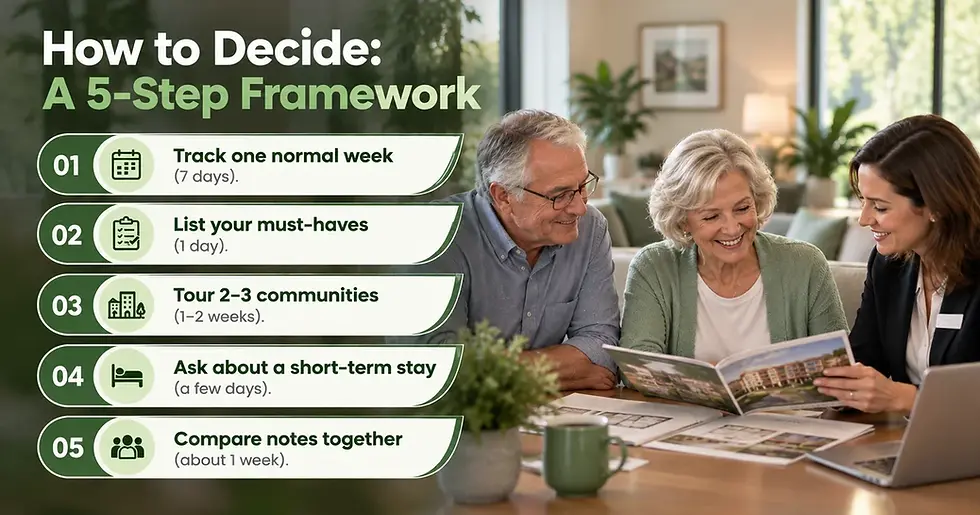
Still weighing the options? Here's the process families find most useful. It typically takes about three to four weeks.
Track one normal week (7 days). Write down the hours spent on chores, errands, and time with other people. The numbers are often surprising.
List your must-haves (1 day). Think private space, a heated pool, a chapel, room for guests, or living close to family in Eureka or the surrounding St. Louis area.
Tour two or three communities (1 to 2 weeks). Visit around lunchtime to see daily life as it actually runs. Our guide on how to choose the right senior living community can help you compare options.
Ask about a short-term stay (a few days). Ask the team what a stay includes and whether it fits your planning.
Compare notes together (about 1 week). Share what each of you noticed, then decide at your own pace with no pressure.
If the idea of moving feels emotional, our piece on the emotional side of moving to a retirement community can help with that part of the conversation too.
Final Thoughts: Choosing How You Want Your Days to Feel
Staying at home gives you familiar rooms and long-held routines. A senior living community gives you time back, built-in friendships, and weeks that aren't shaped by chores. Connection comes more easily when neighbors, meals, and activities share one roof. And freedom feels different when a house isn't asking for your weekends.
Both are valid choices. What matters most is how you want your days to feel.
So start small. Track one normal week. Tour in person. Then ask about a short-term stay and see how it fits.
Retirement should feel like the reward, not the to-do list.
Ready to see the difference for yourself? Visit Victorian Gardens at 15 Hilltop Village Center Dr., Eureka, MO 63025, call 636-587-3737, or book a personal tour online. We'd love to show you around.
FAQs
Is independent living more expensive than staying in my house?
Not always. Once you add up property taxes, insurance, utilities, repairs, lawn care, groceries, and transportation, staying home can cost more than people expect. A senior living community bundles many of those costs into one monthly fee. At Victorian Gardens, pricing depends on apartment size and floor plan, so call 636-587-3737 to request our current rate card and compare both scenarios with real numbers.
How long does it take to move from a house to a senior community?
Timelines vary, but giving yourself about six to eight weeks leaves room for touring, choosing an apartment, downsizing, and booking movers. Deciding what to keep tends to take the longest, so starting with rooms you rarely use helps. Our team can walk you through a realistic timeline based on your situation.
Where can I tour a retirement community nearby?
You can tour Victorian Gardens at 15 Hilltop Village Center Dr. in West St. Louis County. A tour lets you see the apartments and shared spaces, including the heated indoor pool, dining room, and movie theater. Call 636-587-3737, Monday through Friday from 8 a.m. to 5 p.m., or book online. Visiting around lunchtime gives you the best feel for daily life.
Is Victorian Gardens easy for nearby families to visit?
Yes. Victorian Gardens sits minutes from I-44, making visits straightforward for families across the greater St. Louis area. Adult children can stop by after work or on weekends, and residents can host loved ones in the community's shared visiting spaces. Living close enough for a relaxed lunch visit often matters more than families expect when choosing a community for a parent.
Is independent living better than hiring in-home help?
It depends on what matters most. In-home help covers chores or personal care while you stay in a familiar house, but you still manage the property and organize your own social life. A senior living community bundles meals, housekeeping, transportation, and daily activities in one place. If upkeep, quiet days, and the effort of planning social time are all concerns at once, a community setting usually addresses more of them together.
Does Victorian Gardens offer short-term stays?
Yes. Victorian Gardens offers short-term stays. If you'd like to know whether a stay could help you or your parent get a feel for the community, call 636-587-3737. Our team will explain what a stay includes, check availability, and help you plan dates that work for your family.
Why do retirees choose senior living over staying at home?
Most say it comes down to time and connection. Instead of spending weekends on yard work and repairs, residents fill their calendars with dining, swimming, billiards, games, and outings. Families value the peace of mind too. For a lot of people, the move feels less like giving something up and more like getting retirement back.


Comments