
Senior Living Resorts Solve the Hidden Crisis of Isolation

Updated: May 30
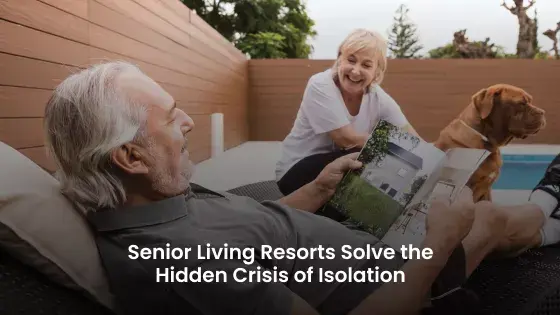
Social isolation among older adults is a documented health crisis linked to cognitive decline, depression, and increased mortality risk. Senior living resorts directly address isolation by providing a built-in social community, structured daily activities, communal dining, and consistent human interaction. Victorian Gardens in Eureka, MO is specifically designed to eliminate senior isolation through community-centered living.
Post-retirement isolation affects 43 percent of seniors living alone at home
Resort-style communities build daily social rhythms into every resident's routine
Structured activities create natural opportunities for connection without pressure
Loneliness directly increases risk of heart disease, dementia, and depression
Victorian Gardens in Eureka, MO actively prevents senior isolation every day
Retirement is supposed to feel like freedom. For millions of Americans, though, the first year after leaving work brings something they didn't expect. The U.S. Surgeon General has warned of deep, persistent loneliness that affects both mental and physical health.
The National Academies of Sciences reports that one in four adults over 65 experiences social isolation. That number climbs sharply for those who don't have a built-in daily routine.
The workplace provided more than a paycheck. It offered structure, identity, and human connection that most people don't realize they've been depending on until retirement arrives.
Senior living resorts in communities like Eureka, Missouri address this crisis head-on. They replace the social scaffolding that disappears at retirement with amenity-rich environments, shared dining, organized activities, and neighbors who become genuine friends.
This isn't about choosing between independence and community. Resort-style senior living proves you can have both. The right community gives residents daily purpose, meaningful relationships, and a rhythm to life that keeps isolation at bay.
Key Takeaways
Post-retirement isolation affects one in four seniors over 65, with health risks comparable to smoking 15 cigarettes daily
Resort-style communities combat loneliness through built-in social structures, shared spaces, and daily programming
Amenity-rich environments naturally bring residents together without forced social interaction
Structured activities and events create organic friendships that deepen over time
Purpose-driven daily rhythms replace the routine and identity that work once provided
Why Post-Retirement Isolation Catches So Many Off Guard
Most people spend decades looking forward to retirement without realizing how much daily structure work provides. The alarm clock, the commute, the colleagues; they're quietly fulfilling social needs.
All of those small daily routines go unnoticed until they vanish. Once they're gone, many retirees can't figure out how to fill the hours that once felt so naturally busy and purposeful.
Dr. Louise Hawkley, a senior research scientist at NORC at the University of Chicago, has studied loneliness for over two decades. Her research highlights a critical pattern that families should understand.
"Retirement removes the single largest source of daily social interaction for most adults. Without a deliberate replacement, isolation sets in gradually, often before the individual even recognizes what's happening." - Dr. Louise Hawkley, Senior Research Scientist, NORC at the University of Chicago
The health consequences are staggering. The U.S. Surgeon General's 2023 advisory found that prolonged social isolation doesn't just feel bad; it increases premature death risk by 26 percent.
It also raises the likelihood of heart disease, stroke, and dementia significantly. These aren't minor risks; they're comparable to the health damage caused by smoking 15 cigarettes every single day.
Isolation and Health Risk: Social isolation among seniors over 65 increases premature death risk by 26 percent and raises heart disease likelihood by 29 percent, making it comparable to smoking daily.
Eureka, Missouri families see this play out regularly. A parent who seemed fine at first becomes withdrawn within months of retiring. Phone calls grow shorter, hobbies fade, and the spark that once defined them doesn't just dim; it disappears quietly.
Resort-style amenities in senior communities change this trajectory entirely. They create natural gathering points where residents cross paths daily, building connections without the pressure of formal social events or forced interaction.
Read More About Beyond Bingo: Top Activities for Seniors That Aren't Boring
How Do Resort-Style Communities Build Daily Social Rhythms?
The answer starts with intentional design. Resort-style communities create environments where social interaction happens naturally. It's woven into the fabric of daily life rather than added as an afterthought or scheduled obligation.
Think about how a vacation resort works. The pool area becomes a gathering spot. The dining room sparks conversation between strangers. Common lounges invite lingering, and you'll find that spontaneous connections form between people from different backgrounds.
Senior living resorts apply this same principle to permanent living. Heated indoor pools, fitness centers, libraries, and theaters become daily destinations. Residents develop routines around these spaces that mirror the structure work once provided.
Morning Routines That Build Belonging
A resident might start their day with a water aerobics class at the heated pool. They'll see the same faces each morning, and conversations begin naturally. Within weeks, these acquaintances become friends who save seats at lunch for each other.
Afternoon Gathering Points
Common areas like putting greens, shuffleboard courts, and reading rooms give residents reasons to leave their apartments. Each trip through shared spaces increases the chance of a meaningful interaction. It's often the highlight of someone's entire day.
Evening Social Anchors
Private theater screenings, game nights, and dining events create evening anchors that prevent the isolation that often peaks after sundown. These regular touchpoints ensure no resident goes an entire day without genuine human connection. That's how it should be.
Discover How Community Living Transforms RetirementSee how resort-style amenities and daily social programming create a vibrant, connected lifestyle for seniors in Eureka, Missouri. |
Why Shared Amenities Create Stronger Senior Connections
Shared amenities do more than entertain. They serve as social catalysts that bring people together around common interests. They're creating organic friendships that structured programs alone can't replicate easily.
Dr. Andrew Steptoe, a professor of epidemiology at University College London, has researched the connection between social environments and senior health outcomes for over fifteen years of study.
"Environments that encourage incidental social contact, shared meals, group exercise, and communal leisure spaces, consistently produce better mental health outcomes than isolated living arrangements, regardless of income level." - Dr. Andrew Steptoe, Professor of Epidemiology, University College London
Community amenities like heated pools and fitness centers attract residents with different backgrounds who share similar interests. A retired teacher and a former engineer might discover a mutual love of swimming, and a friendship forms.
This organic connection-building matters because forced socialization often backfires. Many seniors resist structured social programs because they don't feel genuine or natural.
Shared amenities remove that barrier entirely. They let friendships develop naturally around common interests, and there's no pressure to join conversations you didn't choose on your own.
Concierge services also play a quiet but powerful role. When transportation, scheduling, and daily logistics are handled, residents have more energy and willingness to participate in community life around them.
How Structured Events Turn Neighbors Into Lifelong Friends
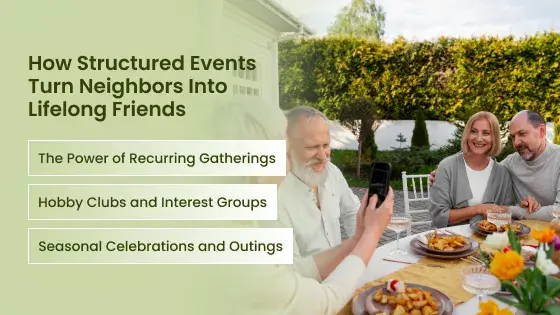
Structured events and activities accelerate what organic connections start. The best senior living resorts pair shared spaces with weekly game nights and fitness classes. It's a proven formula.
Holiday celebrations, group outings, and hobby clubs add even more layers. These recurring gatherings deepen bonds in ways that casual encounters alone can't match, and that's what makes the difference long-term.
The Journal of Aging and Health published research showing that seniors who participate in regular group activities report 40 percent lower rates of depression.
Socialization and Depression: Seniors who engage in weekly group activities show 40 percent fewer depressive symptoms compared to those who socialize only with family or infrequently.
The Power of Recurring Gatherings
One-time events create memories, but recurring gatherings build relationships. A weekly bridge group or a Monday morning walking club gives residents something to look forward to. It's a reason to get dressed and show up every single week.
Hobby Clubs and Interest Groups
Book clubs, gardening groups, art classes, and cooking workshops connect residents through shared passions. These interest-based groups often become the strongest social circles within a community because they're built around what people genuinely love.
Seasonal Celebrations and Outings
Holiday parties, seasonal festivals, and group trips to local Eureka attractions give residents collective experiences. Shared laughter and new adventures create the kind of stories that neighbors retell for years. You can't put a price on that bond.
Events and activities programming in resort-style communities goes far beyond basic entertainment. It creates the social infrastructure that retirees lost when they left the workplace, rebuilt in a warmer and more intentional way.
Explore Our Vibrant Activity CalendarFrom fitness classes to holiday celebrations, our Eureka, Missouri community offers something meaningful every single day of the year. |
Can Purpose-Driven Living Reverse Retirement Loneliness?
Yes, and the evidence is compelling. Purpose is the missing ingredient that separates seniors who thrive from those who merely exist after retirement. Resort-style communities provide that purpose, and it's delivered through daily structure and meaningful engagement.
Dr. Patricia Boyle, a neuropsychologist at Rush University Medical Center in Chicago, has published extensively on purpose and aging. Her longitudinal studies reveal striking patterns about what keeps seniors healthy.
"Older adults who report a strong sense of purpose in life are 2.4 times more likely to maintain physical independence and show significantly slower cognitive decline. Community environments that provide daily structure and social roles directly support this sense of purpose." - Dr. Patricia Boyle, Neuropsychologist, Rush University Medical Center
Senior apartments in resort-style communities become home bases rather than hiding places. Residents wake up with places to go, people to see, and roles to fill within their community each morning.
Concierge services remove the daily burdens that drain energy, like scheduling appointments and handling errands. This frees residents to invest their time in activities that bring genuine fulfillment and joy.
Purpose-Driven Living: Seniors who report a strong sense of daily purpose are 2.4 times more likely to maintain physical independence and show measurably slower cognitive decline over time.
Some residents volunteer to welcome newcomers. Others lead hobby groups or organize community garden projects. These small roles create the same sense of contribution and identity that a career once provided. They're more important than most people realize.
What Should Eureka Families Look for in a Senior Community?
Not all senior communities address isolation equally. Families in the Eureka, Missouri area should evaluate specific features that indicate a genuine commitment to resident social wellness. Here's what to look for.
Social Programming Depth
Look beyond the brochure highlights. Ask how many weekly activities the community offers and whether residents help shape the programming. Communities that involve residents in planning don't just create activities; they create ownership.
Amenity Accessibility
Resort-style amenities should be conveniently located and designed for daily use, not just occasional visits. A heated pool that residents pass on the way to the dining room gets more use than one tucked in a far corner.
Staff-to-Resident Relationships
Family-owned communities often excel here because staff members build genuine relationships with every resident. Corporate chains may rotate staff frequently, and that doesn't allow the deep personal connections that combat isolation most effectively.
Apartment Design for Independence
Apartment options should feel like a real home, not an institutional room. When residents can personalize their space with their own furniture and memories, they maintain identity and invite neighbors over with pride.
Read More About The Role of Fitness Programs in Senior Living Communities
Isolation Statistics Every Retiree and Family Should Know
Understanding the scope of post-retirement isolation helps families in Eureka and the greater St. Louis area make informed decisions. These data points come from leading health organizations and peer-reviewed research.
Statistic | Source |
1 in 4 adults over 65 experience social isolation | National Academies of Sciences |
Social isolation increases premature death risk by 26% | U.S. Surgeon General Advisory, 2023 |
Loneliness raises dementia risk by 50% | |
Isolated seniors have 29% higher risk of heart disease | American Heart Association |
Group activity participants show 40% lower depression rates | Journal of Aging and Health |
These numbers tell a clear story. Research published by the National Institute on Aging confirms that isolation isn't just an emotional challenge. It's a measurable health risk that shortens lives and accelerates cognitive decline.
Families who recognize these risks early can take proactive steps. Moving to a senior living resort community before isolation takes root is far more effective than trying to reverse loneliness after it's already set in deeply.
Take the First Step Toward Connected LivingYour next chapter deserves purpose, friendship, and a community that feels like home every single day. |
Conclusion
Retirement isolation is a real and growing crisis, but it's also one of the most solvable challenges facing older adults today. The right community replaces workplace social structures with something even richer: genuine friendships, daily purpose, and an environment that's designed for connection.
Victorian Gardens in Eureka, Missouri was built on the belief that every resident deserves a vibrant, socially rich life surrounded by people who care. Resort-style design, thoughtful programming, and a family-owned approach create the kind of community where loneliness simply cannot take hold.
If you or someone you love is navigating the transition to retirement, don't wait for isolation to settle in. Contact us to learn how community living can transform this next chapter into the most connected and fulfilling season of life.
FAQs
What amenities should seniors prioritize when choosing a retirement community?
Priority amenities include chef-prepared dining, fitness facilities, wellness programs, social event spaces, outdoor areas, transportation, and beauty services. These features directly impact daily quality of life and community satisfaction. At Victorian Gardens in Eureka, Missouri, all of these are available on one beautifully maintained campus.
How do dining programs in senior living communities support resident health?
Quality senior dining programs provide nutritionally balanced, chef-prepared meals designed to support specific health needs, dietary restrictions, and personal preferences. Communal dining also serves as a key social activity that boosts mood and encourages consistent eating habits. At Victorian Gardens in Eureka, Missouri, our culinary team prepares three restaurant-quality meals daily using fresh, wholesome ingredients.
What resort-style amenities are available at Victorian Gardens?
Victorian Gardens in Eureka, Missouri features chef-prepared dining with daily menu choices, a heated swimming pool, fully equipped fitness center, beauty salon, library, movie lounge, gardening areas, and scheduled transportation for appointments and outings. All amenities are included and designed to support an active, comfortable, and socially rich lifestyle.
How often are amenities and activity programs updated at senior living communities?
Leading senior living communities review and refresh their activity calendars monthly and update amenity offerings based on resident feedback and seasonal programming. At Victorian Gardens in Eureka, Missouri, our activities director solicits resident input regularly and our facility team ensures all amenity spaces are maintained to the highest standard year-round.
How do I schedule a tour at Victorian Gardens in Eureka, Missouri?
Scheduling a tour at Victorian Gardens in Eureka, Missouri is simple - call our team at 636-587-3737, complete the contact form on our website, or click the Book a Tour button. Tours are available Monday through Saturday and are fully personalized so you see exactly what matters most to your family.


Comments